The Economic Kill Chain
What States Can Learn from Wall Street

The most sophisticated practitioners of financial warfare are not in government. They are on Wall Street.
Activist investors, distressed debt funds, and short sellers have spent decades perfecting the art of financial targeting. They gather intelligence on corporate vulnerabilities. They map network dependencies. They position capital before striking. They coordinate with allies. They exploit secondary effects. They measure outcomes against objectives. This is the Economic Kill Chain, executed quarterly, for profit.
States are only now discovering what hedge funds have known for forty years: capital is a weapon system. The question is whether government institutions can learn fast enough to match adversaries who already operate at market tempo.
The Kill Chain in Private Hands
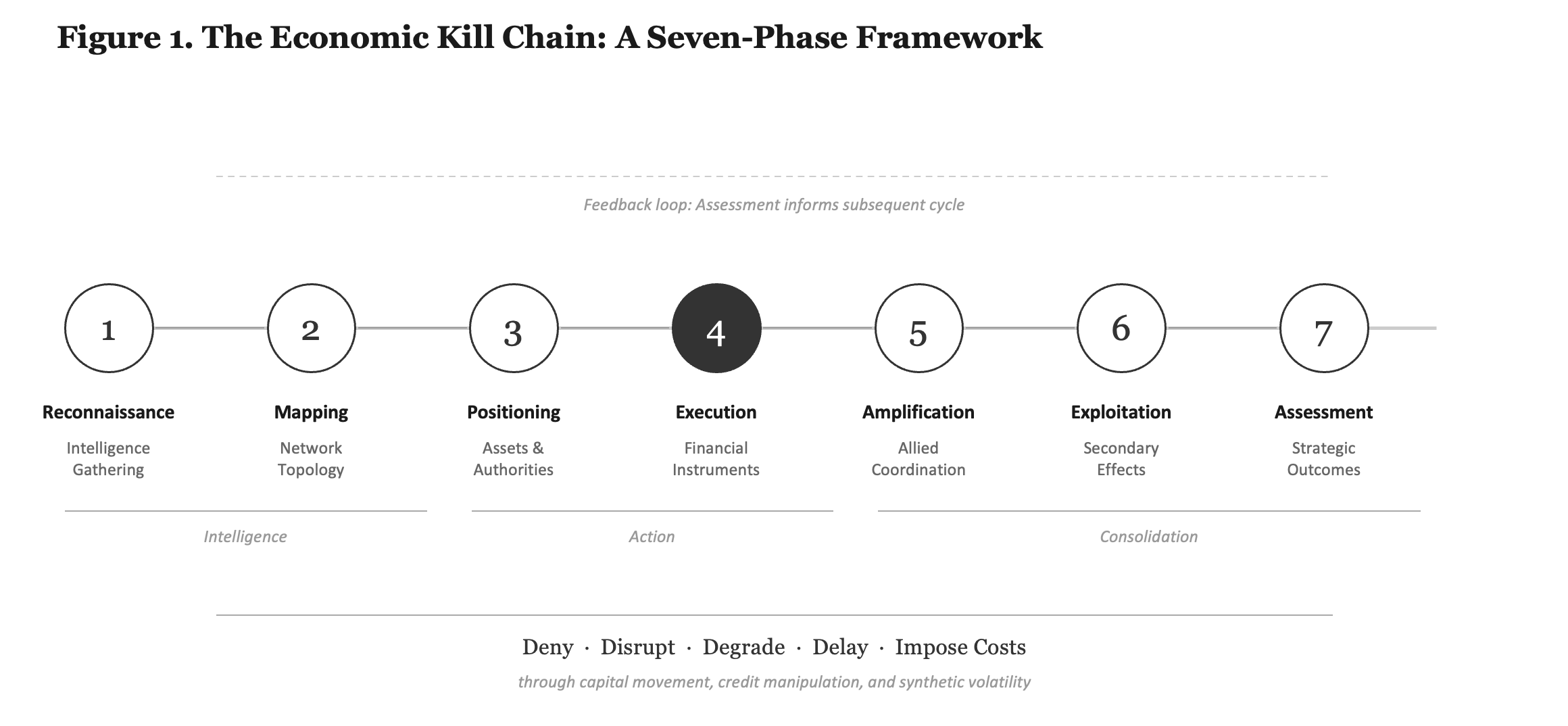
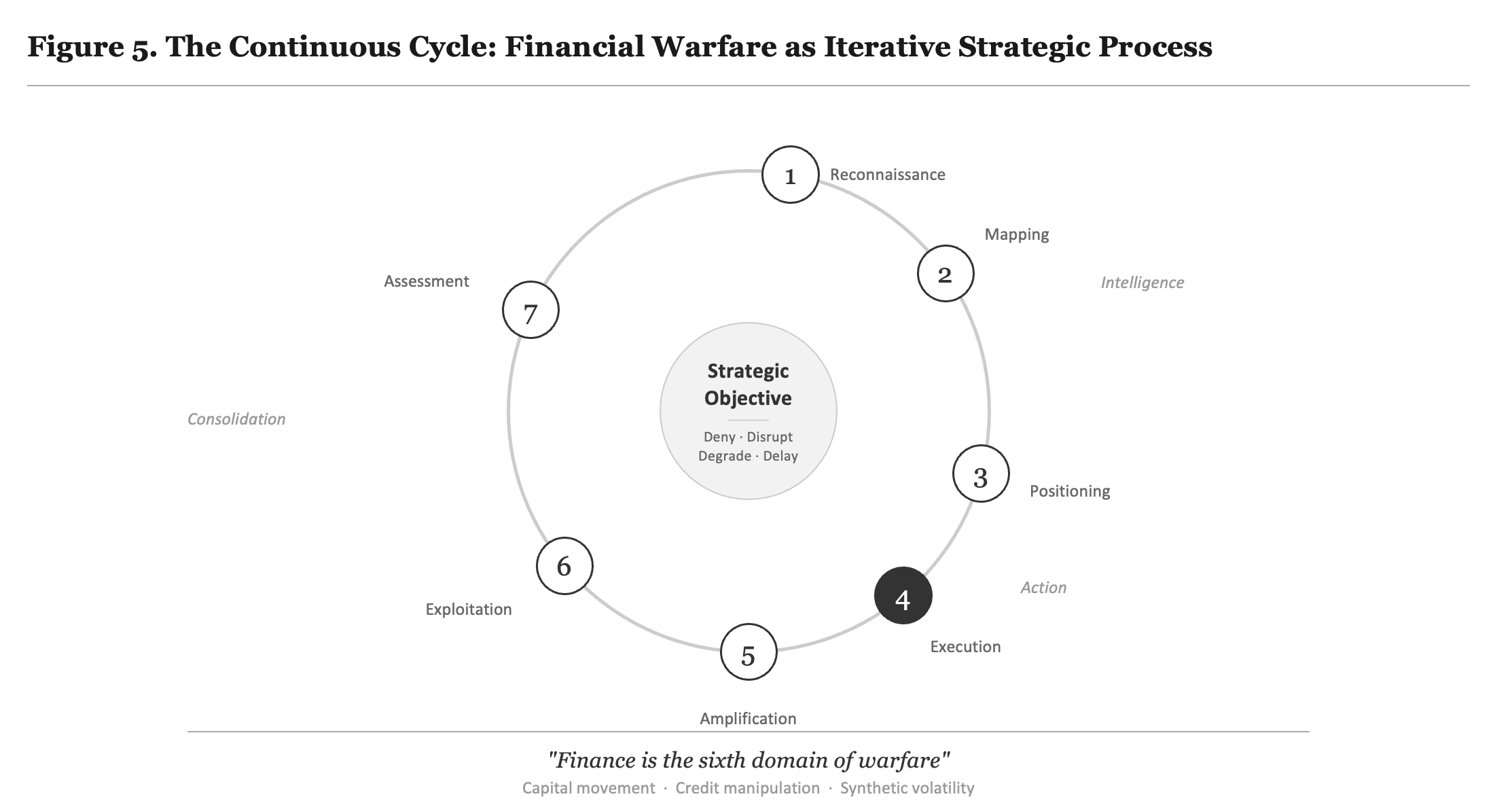
The Economic Kill Chain comprises seven phases: Reconnaissance, Mapping, Positioning, Execution, Amplification, Exploitation, and Assessment. Each phase has a direct analogue in activist investing.
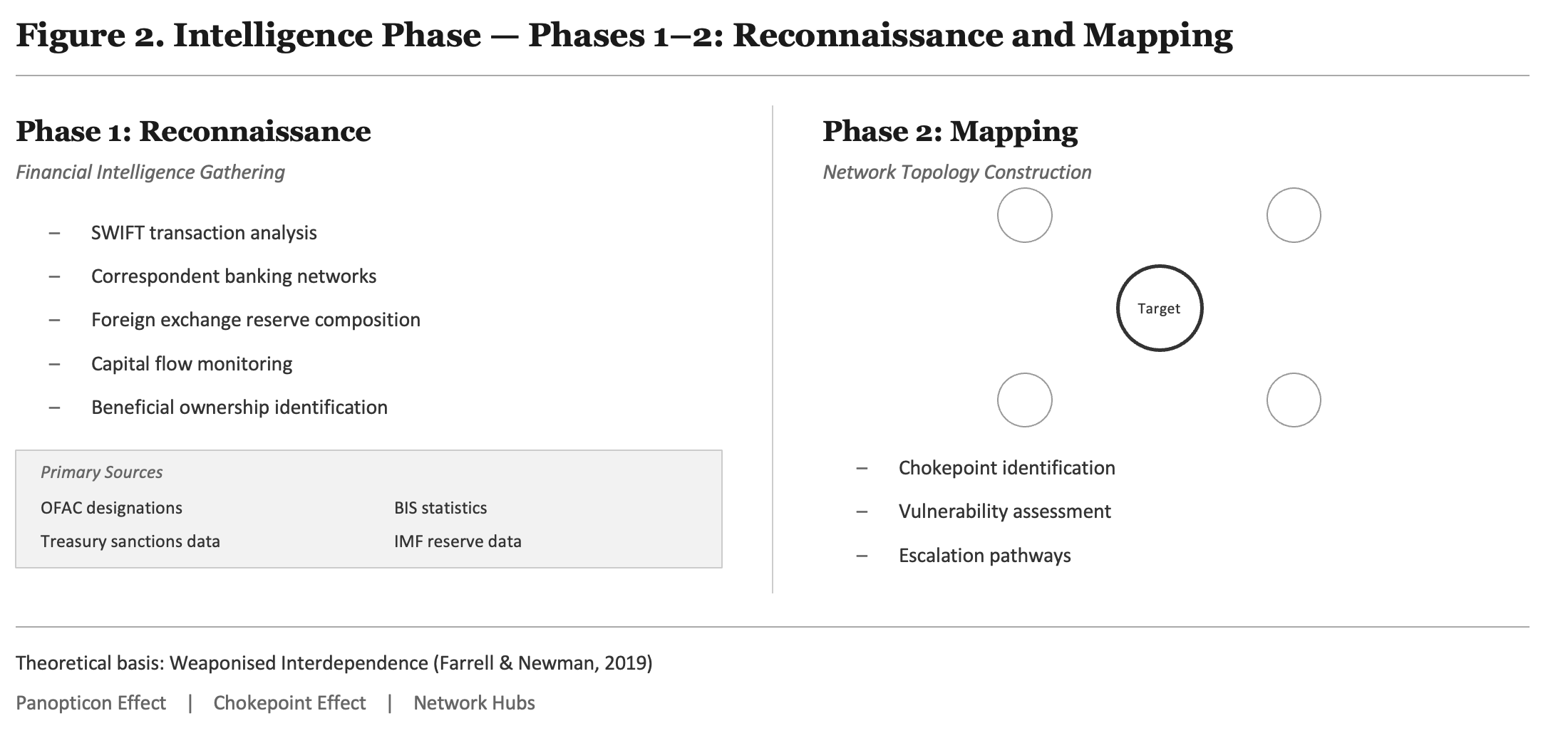
Reconnaissance in the private sector means forensic accounting, supply chain analysis, and management due diligence. Firms like Muddy Waters and Hindenburg Research have built entire business models on financial intelligence gathering. They deploy analysts to count trucks in parking lots, interview former employees, and parse footnotes in SEC filings. The goal is identical to state intelligence: understand the target’s financial architecture before acting.
Mapping means identifying the nodes and links that constitute the target’s ecosystem. Which banks provide credit facilities? Which counterparties depend on the target’s solvency? Where are the covenant triggers? Activist investors construct network topologies as sophisticated as anything produced by OFAC. They distinguish between critical chokepoints and redundant pathways. They identify where pressure will propagate and where it will dissipate.
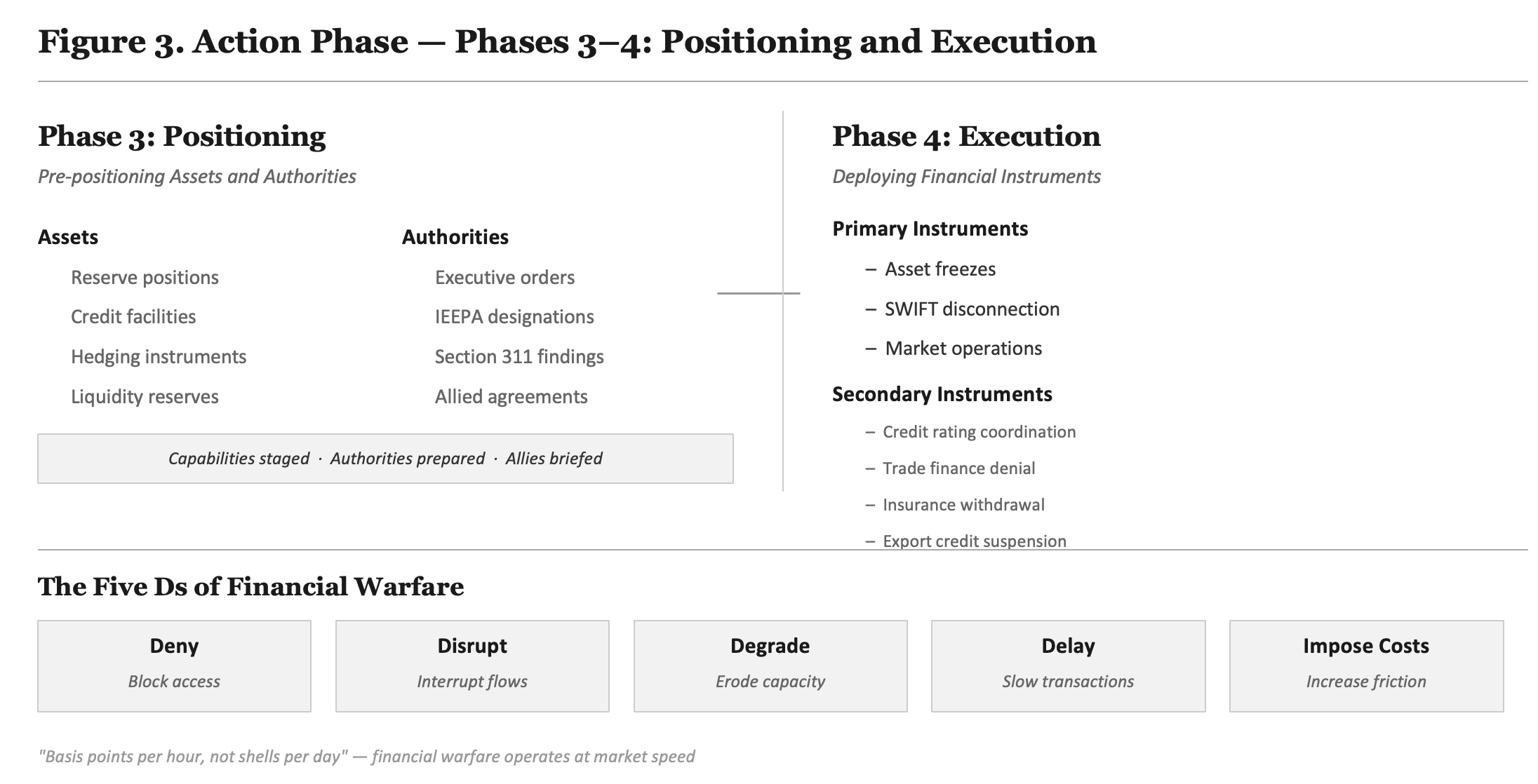
Positioning means accumulating capital before the market recognises your thesis. This is the quiet phase: building a stake, securing borrow for short positions, lining up financing for a proxy fight. The parallel to government positioning is exact. Assets and authorities must be staged before execution. The goal is to compress the time between decision and effect.
Execution in activist campaigns takes many forms: public letters, proxy contests, short reports, credit default swap positions. The instruments differ from government tools, but the logic is identical. Primary actions impose direct costs. Secondary instruments extend pressure across the target’s network.
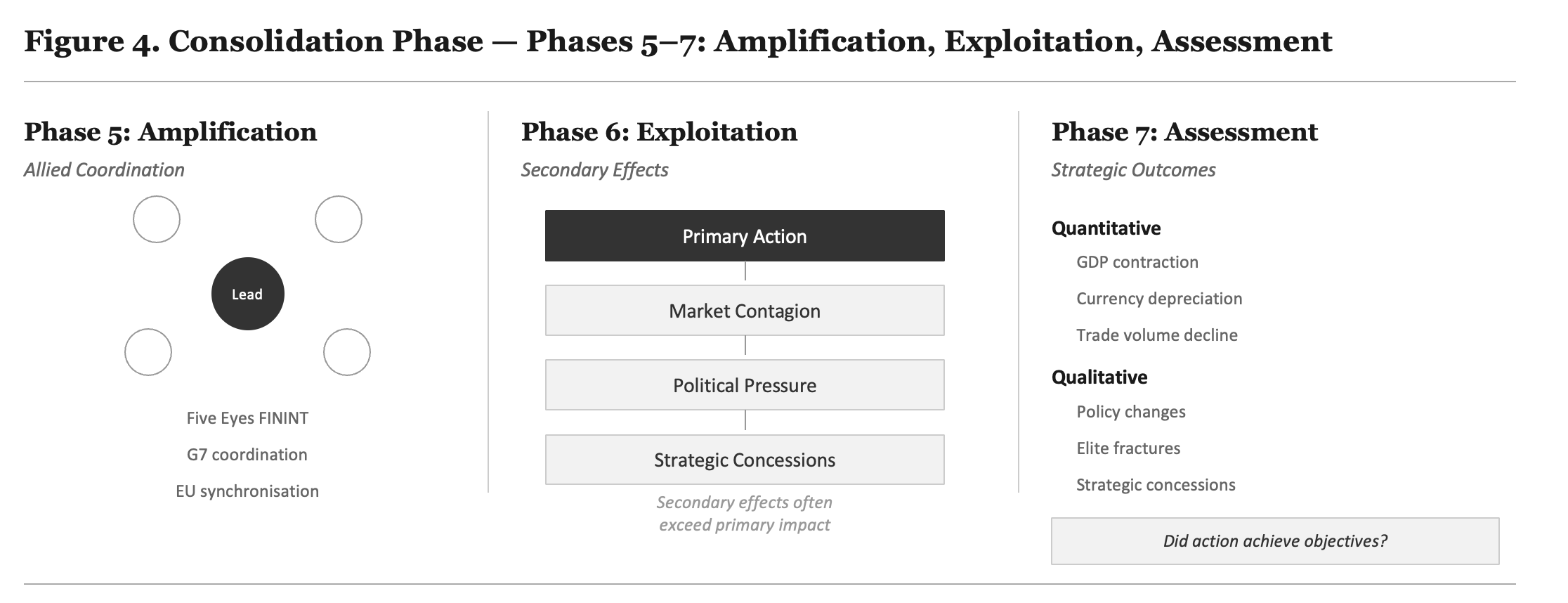
Amplification means coordinating with allies. Wolf packs of hedge funds share intelligence and coordinate positions. Institutional shareholders are lobbied to support activist agendas. Media campaigns shape the narrative. The private sector understood force multiplication long before defence strategists applied it to sanctions coordination.
Exploitation extracts value from secondary effects. A short seller profits not just from the initial price decline but from the cascade: credit downgrades, covenant breaches, management distraction, customer defection. Sophisticated operators position for the second and third order effects, not just the primary impact.
Assessment is continuous. Positions are marked to market daily. Thesis validity is tested against price action. Capital is reallocated based on outcomes. The feedback loop is tighter than any government review cycle.
The Tempo Gap
The private sector operates the Economic Kill Chain at a tempo that government institutions cannot match. A hedge fund can move from reconnaissance to execution in weeks. A government sanctions programme takes months or years.
This tempo gap reflects structural differences. Private actors face market discipline: capital flows to strategies that work and away from those that do not. Government agencies face bureaucratic discipline: processes must be followed, authorities must be obtained, allies must be consulted. The former selects for speed. The latter selects for caution.
The gap matters because adversaries are closing it. China’s Military-Civil Fusion doctrine deliberately blurs the line between state and market actors. Russian oligarchs operate as instruments of state power while maintaining commercial cover. The distinction between public and private financial warfare is eroding, but Western governments still organise as if it remains absolute.
What States Can Learn
Three lessons from the private sector apply directly to state financial warfare.
First, intelligence must be operationalised, not just collected. Hedge funds do not gather information for its own sake. Every data point serves a thesis. Every analysis implies a trade. Government financial intelligence often sits in reports that inform but do not compel. The Economic Kill Chain demands that reconnaissance and mapping produce actionable targeting, not background briefings.
Second, positioning determines outcome. The returns to activist investing accrue disproportionately to those who position before the market moves. The same logic applies to state action. Authorities prepared in advance, assets pre-staged, allies pre-briefed: these compress execution timelines and maximise impact. Reactive financial warfare, assembled after a crisis begins, arrives too late to shape outcomes.
Third, the cycle must be continuous. Private capital markets provide real-time feedback on thesis validity. Government programmes often lack equivalent mechanisms. Assessment must be embedded in operations, not conducted as post-hoc review. The Kill Chain is a loop, not a line.
The Institutional Implication
Australia lacks institutions designed for financial warfare at market tempo. Treasury manages economic policy. DFAT manages diplomacy. Home Affairs manages border security. Defence manages kinetic capability. AUSTRAC monitors transactions. ASD conducts cyber operations. No single entity owns the mission of deploying financial instruments for strategic effect.
The private sector solved this problem decades ago. Trading desks integrate research, execution, and risk management under unified command. The entire Kill Chain operates within a single organisational structure with clear authority and accountability.
A dedicated Financial Warfare Office would apply this logic to government. It would integrate FININT collection, network analysis, legal authorities, allied coordination, and assessment under single leadership. It would operate at tempo closer to market speed than bureaucratic speed. It would treat capital as a weapon system, not an administrative input.
The Doctrinal Foundation
The Economic Kill Chain provides the doctrinal foundation for this institutional change. The seven phases describe how financial warfare campaigns unfold. The framework applies whether the operator is a hedge fund targeting a corporation or a state targeting an adversary. The logic is the same. The instruments differ. The tempo must converge.
This is the first in a series examining the Economic Kill Chain in detail. Subsequent articles will apply the framework to specific domains: critical minerals, semiconductor supply chains, correspondent banking networks, and sovereign wealth fund dependencies. The goal is to build a shared vocabulary for financial warfare that bridges the gap between private practice and public doctrine.
Finance is the sixth domain of warfare. The private sector has been fighting in this domain for decades. It is time for states to learn from the practitioners who mastered it first.